The carcass: four constructions and what they cost you
Every belt is rubber around a tension-bearing carcass. The four common constructions trade cost against stretch and impact behaviour:
- EP (polyester warp / nylon weft) — the default for most industrial conveying. Low stretch, good impact resistance, keeps tension over long centres.
- NN (nylon / nylon) — higher elongation absorbs shock loading; used where material arrives in surges and the take-up can absorb the stretch.
- CC (cotton / cotton) — the traditional carcass. Lower tensile, but excellent grip on small pulleys and troughing; still specified for short, light-duty runs and legacy machinery.
- ST (steel cord) — long-centre, high-tension lines: mining overlands, steep inclines. Minimal elongation, highest tensile, and it is what makes high-incline designs possible at all.
Carcass comparison
| Carcass | Tensile | Elongation | Use it for | Watch out for |
|---|---|---|---|---|
| EP | Medium–high | Low | General industrial conveying, medium–long centres | Needs proper take-up allowance on retrofit |
| NN | Medium | Higher | Shock loading, surge-fed lines | More stretch — take-up must absorb it |
| CC | Lower | Moderate | Short light-duty runs, small pulleys, legacy lines | Lower tensile limits length and load |
| ST | Highest | Minimal | Long-centre, high-tension, steep incline, mining | Splicing requires specialist tooling |
Belt widths 300–2,200 mm, cover tensile 10–24 MPa, minimum order 100 m. Final construction confirmed per quotation.
Cover compound: match it to the material, not the brochure
Cover rubber is specified by what it must survive: abrasive sharp stone (aggregate), heat from clinker or hot sinter (heat-resistant grades), grain dust in suspension (flame-retardant and anti-static grades for safety compliance), or oily materials that swell standard rubber. Tensile figures in the 10–24 MPa range describe cover quality, not the whole belt — a high tensile cover on the wrong carcass still fails at the splice.
Profiles: when chevron pays for itself
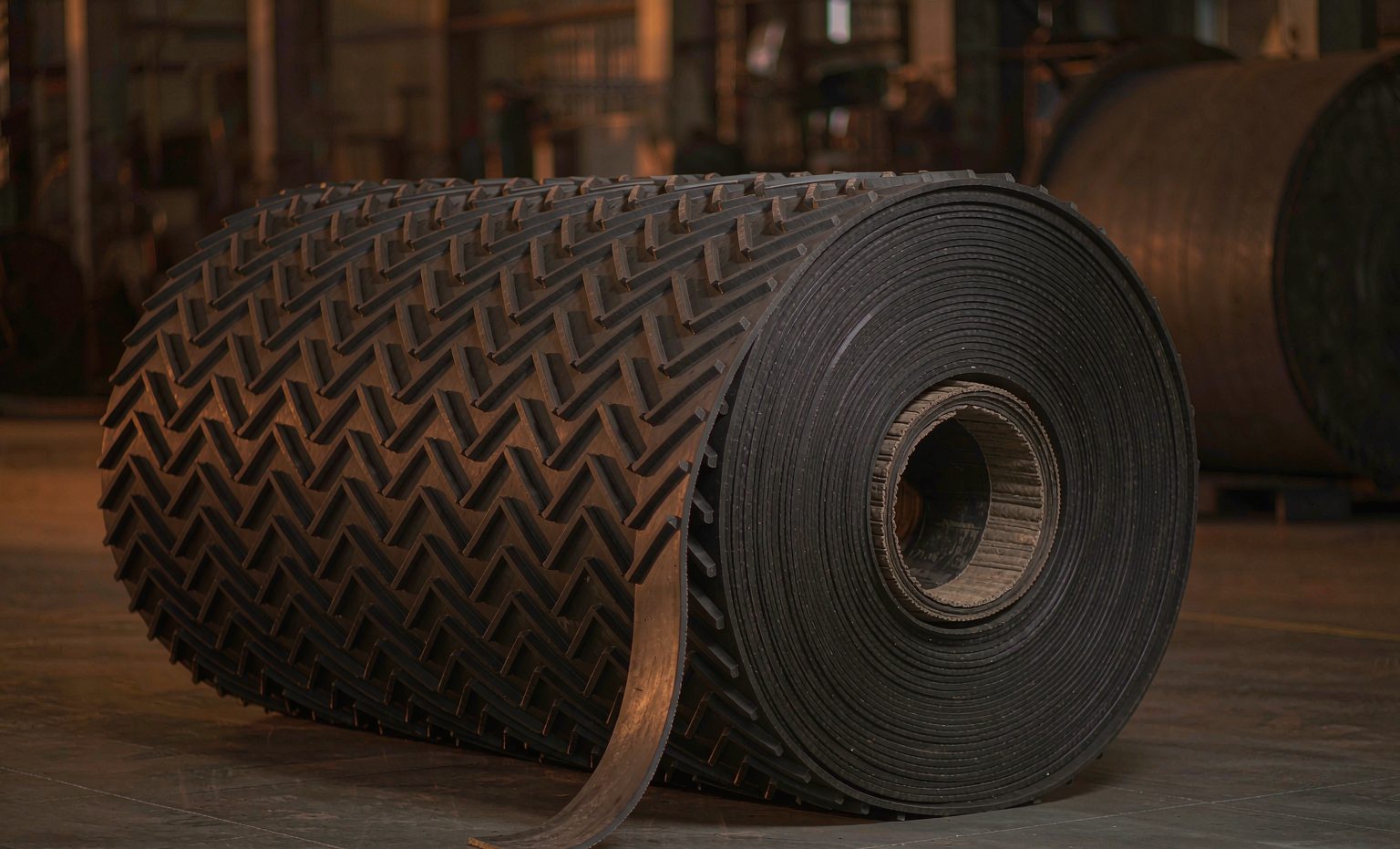
A smooth cover on an incline above roughly 15–18 degrees starts to roll material back, especially in wet conditions. Chevron (V-pattern) or multi-V profiles grip loose material the way tread grips a road, and they are the difference between a 20-degree belt that works and one that needs three times the length to gain the same height. Sidewall designs go further for steep, compact installations.
Specifying tip. Send the incline angle, material lump size and whether the material is wet. Profile height and pitch are quoted against those three numbers — guessing them from a photo is how belts come back underspec'd.
Widths, minimums and the splice question
Belts run 300–2,200 mm wide in our range, supplied per 100 m minimum. Carcass construction (EP / NN / CC / ST) is confirmed per application because the take-up system and pulley diameters on your line constrain the choice. Tell us the existing splice type when re-belting — a carcass change can require a different splice method and your fitters' tooling should match.