Rubber conveyor belts for aggregate, cement and mining
Chevron and multi-V profiles for inclined haulage, sidewall belts where spillage is unacceptable, steel cord where the run is long and the load is heavy, flame-retardant ST grades to MT668-2008 for coal.
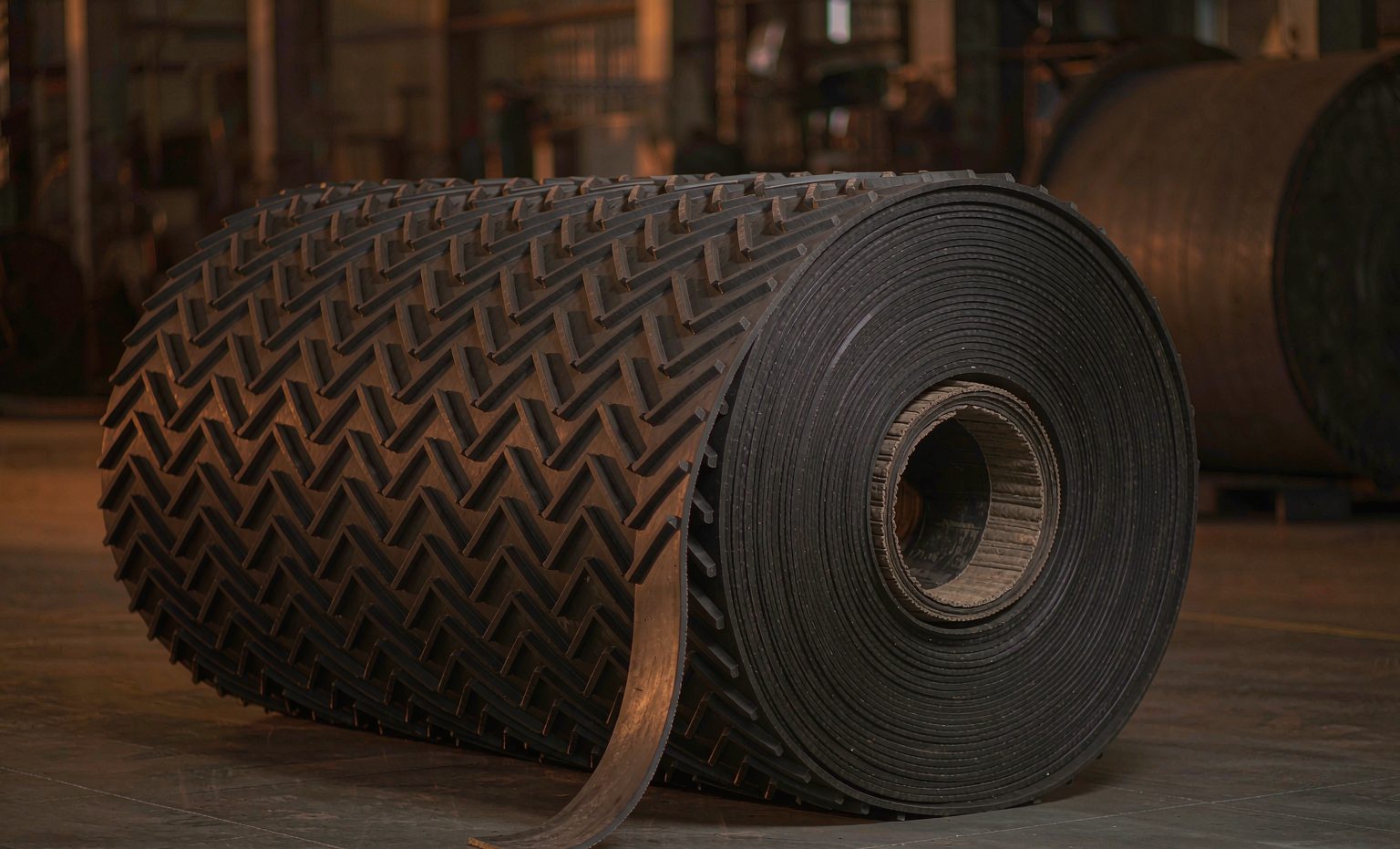
Belt selection starts with three numbers: belt width, incline angle and material size. Widths run from 300 mm to 2,200 mm. Adhesion between cover and carcass runs from 10 to 24 MPa — the higher the number, the longer the belt survives impact loading at the transfer point.
For coal and underground work, specify the flame-retardant ST series to MT668-2008. For hot material, specify a heat-resistant cover rather than a thicker standard cover.
Spillage is a belt spec, not an operator problem. Where material escapes at the incline, a sidewall belt removes the skirt board and the clean-up labour with it.
Eight belt types.
Minimum order 100 m. Belt width, cover grade and carcass are confirmed per quotation.
| Belt type | Width | Key specification | Typical use |
|---|---|---|---|
| V-chevron belt | 300–1,400 mm | Black, abrasion-resistant cover | Aggregate, mining — inclined haulage |
| Narrow chevron belt | 300–600 mm | Narrow-profile cleats | Fine material on steep inclines |
| Steel cord belt | On request | 10–24 MPa adhesion, anti-delamination | Cement and long-distance conveying |
| Sidewall belt | 400–2,200 mm | EP / NN / CC carcass, zero-spillage edge | Ore and bulk where spillage is not acceptable |
| Multi-V belt | On request | Open or closed profile | Road construction aggregate |
| High-incline chevron | On request | Anti-slip chevron face | Grain, fertiliser, wood chips |
| Heat-resistant chevron | On request | High-temperature cover compound | Geothermal, sinter, hot minerals |
| Flame-retardant ST belt | On request | ST series, MT668-2008 | Coal and underground bulk handling |
Carcass construction (EP / NN / CC / ST) is specified per application.
EP grades, in numbers.
Polyester warp, nylon-66 weft. Low elongation in the warp and good troughing in the weft — the reason EP is the default for medium and long centre distances.
| Grade | Ply thickness (mm / ply) | Single fabric strength (N/mm) | Cover upper / lower (mm) | Width (mm) | Length (m) |
|---|---|---|---|---|---|
| EP-100 | 0.80 | 100 | 2.0–8.0 / 0–4.5 | 400–2,000 | 20–300 |
| EP-125 | 0.85 | 125 | 2.0–8.0 / 0–4.5 | 400–2,000 | 20–300 |
| EP-150 | 0.90 | 150 | 2.0–8.0 / 0–4.5 | 400–2,000 | 20–300 |
| EP-160 | 0.90 | 160 | 2.0–8.0 / 0–4.5 | 400–2,000 | 20–300 |
| EP-200 | 1.05 | 200 | 2.0–8.0 / 0–4.5 | 400–2,000 | 20–300 |
Cover thickness is quoted per side: 2.0–8.0 mm top, 0–4.5 mm bottom. Widths 400–2,000 mm, roll lengths 20–300 m.
Oil and cold grades.
Two families where the cover compound, not the carcass, decides how long the belt lasts.
| Grade | Tensile strength (MPa) | Elongation at break | Max abrasion loss (mm³) | Polymer | Working temperature | Application |
|---|---|---|---|---|---|---|
| OR | 15 | 300% | 150 | NBR blend | −30 to +60 °C | Grain, refuse, woodchips, oil-coated fertiliser, coated coal and coke |
| MOR | 12 | 300% | 300 | NBR blend | −30 to +50 °C | Grain, refuse, recycling waste, wood pulp, pinewood — moderate oil load |
Oil-resistant grades. State the oil type and concentration in the inquiry — vegetable, mineral and solvent oils need different compounds.
| Class | Carcass or cover | Compound | Working temperature | Typical use |
|---|---|---|---|---|
| C1 | Cotton, nylon or EP canvas | NR / BR blend | −45 to +50 °C | Outdoor conveying in freezing areas |
| C2 | Cotton, nylon or EP canvas | NR / BR blend | −45 to +50 °C | Cold stores and refrigerated handling |
| H | Cover grade | Laceration resistant | −45 to +50 °C | Sharp, jagged material at low temperature |
| D | Cover grade | Abrasion resistant | −45 to +50 °C | Abrasive bulk at low temperature |
| L | Cover grade | Ordinary | −45 to +50 °C | General cold-weather duty |
C1 and C2 are cold-resistance classes; H, D and L describe the cover compound. Both are stated on the quotation so the belt can be checked on arrival.
Below −40 °C the cover is the limit, not the carcass. Standard compounds stiffen and crack at the punch holes before the fabric fails. Cold-resistant belts use an NR/BR blend that keeps working to −40 °C and is rated to −45 °C working temperature. If your cold store runs a fast-acting door, say so — the belt grade and the door curtain are specified together.
What the surface does.
Maintenance items.
Send belt width, incline angle and material.
Add the throughput and the transfer height if you have them. We will propose the profile and the cover grade.