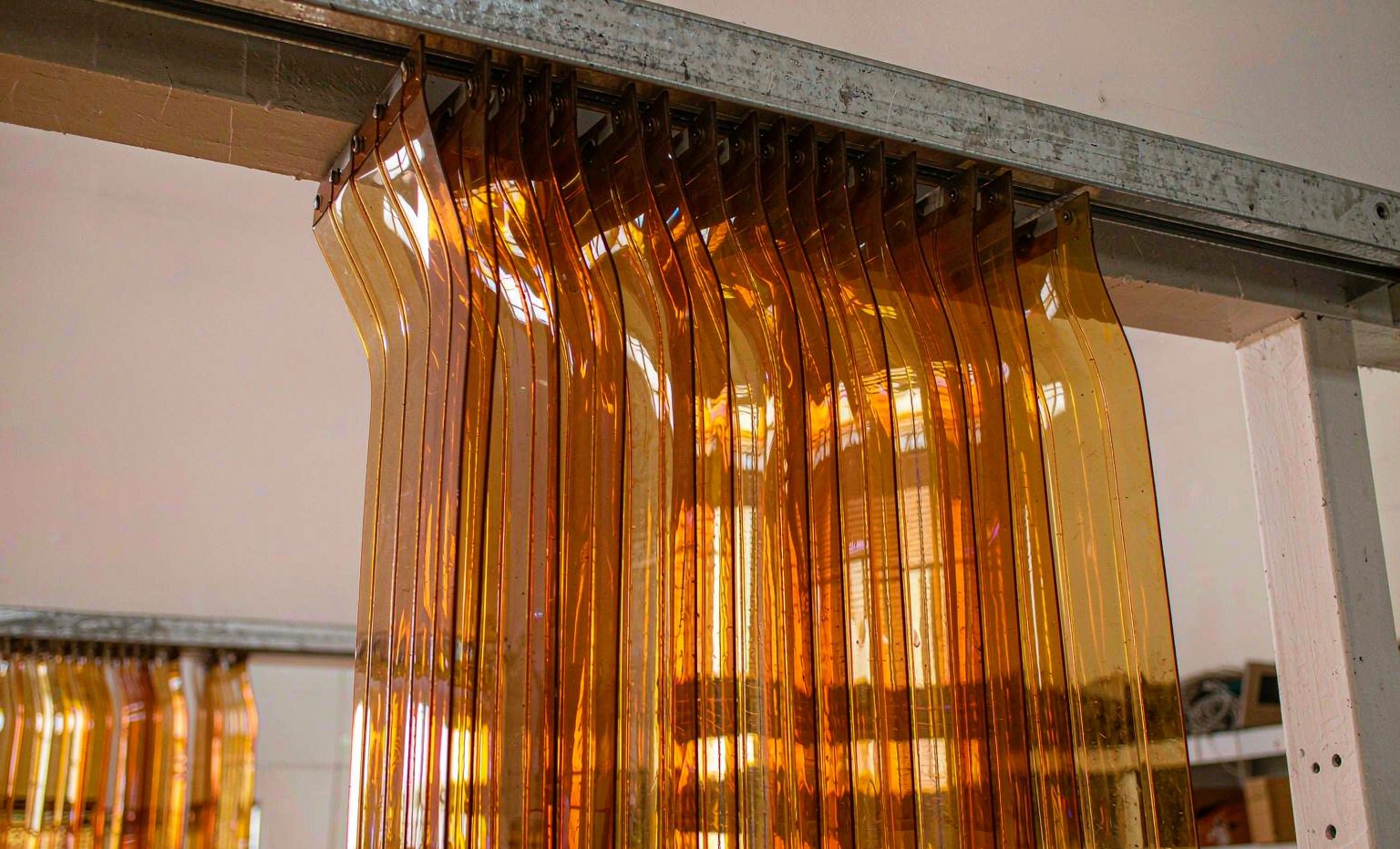
What thickness actually changes
Three things scale with strip thickness: impact resistance, flex life and price per square metre. A 2 mm strip is the economy choice for pedestrian doors. A 3 mm strip is the workhorse for mixed foot and trolley traffic. A 4 mm strip earns its cost where pallet trucks and forklifts pass through the same opening all day.
What thickness does not change is sealing performance — a 2 mm curtain overlaps and seals the same way a 4 mm one does. If draughts and dust are the only problem, going thicker is wasted money.
The quick answer by door type
| Strip thickness | Traffic level | Typical door | Watch out for |
|---|---|---|---|
| 2 mm | Light pedestrian | Internal partitions, clean areas, low-use doorways | Trolley wheels and kick damage shorten life sharply |
| 3 mm | Mixed pedestrian + trolley | Warehouse exits, production corridors, shop floors | Centre strips wear first on forklift routes |
| 4 mm | Forklift / pallet truck | Loading bays, despatch doors, high-cycle openings | Heavier to push through for pedestrians — rib it |
All three thicknesses are available in 100–400 mm widths, in 25 m or 50 m rolls, across our nine strip grades.
Traffic is the deciding factor, not door size
A wide door with two people walking through it twice an hour is a light-duty door, whatever its dimensions. A narrow door on a picking route where pallet trucks cross every few minutes is a heavy-duty door. Count the crossings on your busiest day before you choose — that number matters more than the doorway measurements.
Where forklifts pass through, add one more safeguard regardless of thickness: nylon-reinforced strip. Reinforcement stops a tear from propagating down the full strip after a hard knock, which is how most curtains actually die.
Temperature changes the compound first, thickness second
Thickness does not keep PVC flexible in a freezer — the plasticiser does. Standard DOP compounds stiffen as temperatures drop toward freezing; below that, strips crack at the punch holes and lose their overlap. For cold rooms we recommend DOTP-based compound, which holds flexibility at lower temperatures, and we explain the full trade-off in our cold room strip curtain guide.
Rule of thumb. Ambient doors: choose by traffic. Chilled or frozen doors: choose the compound first (DOTP), then apply the same traffic logic to thickness.
Ribbed or flat at the same thickness?
Double-ribbed strip solves one specific failure: strips sticking together and getting dragged open. Ribs keep the strip faces apart, so doors with fast, repeated pedestrian traffic stay sealed without people having to push the curtain aside. If your problem is strips parting and staying open, ribbing fixes it without moving up a thickness class.
Mixing thicknesses in one doorway
For doors where pedestrians and forklifts share the opening, a common setup is 4 mm strips on the drive-through centre band and 3 mm strips on the pedestrian edges. You get the durability where impacts happen and a lighter push-through where people pass. We cut and punch both to the same rail, so the door ships as one kit.